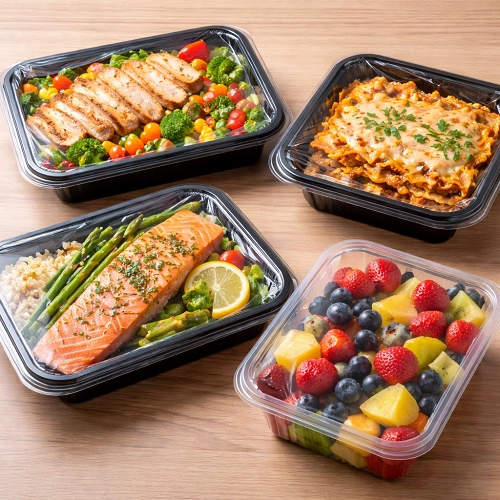

Lidding films are a critical component in modern food packaging systems, especially where freshness, safety, convenience, and sustainability intersect. From microwavable trays to vacuum-sealed containers, these engineered polymer films act as the final barrier between food and the external environment.
What Are Lidding Films?
Lidding films are thin, flexible polymeric films used to seal containers such as trays, cups, tubs, and pouches. They serve as the final closure in packaging lines, protecting the product from contamination, moisture, oxygen, light, and other environmental stressors. Typical sealing methods include heat sealing, peelable adhesives, cold welding, and ultrasonic bonding.
Unlike primary packaging films that wrap around the product, lidding films are usually die-cut or roll-stock films applied over rigid or semi-rigid substrates.
Key Functions of Lidding Films
Lidding films perform several essential roles:
Barrier Protection
- Oxygen and moisture barriers to prevent oxidation, staling, and microbial growth.
- Aroma and flavor retention to preserve sensory qualities.
- Light barriers, especially for photodegradable foods like dairy and oils.
Mechanical Protection
- Resistance to puncture, tear, and abrasion during transport and storage.
- Structural integrity to maintain package shape under vacuum or pressure.
Sealing and Peelability
- Strong seals to ensure tamper resistance and prevent leaks.
- Controlled peelability to balance user convenience with product protection.
Printability and Branding
- High-resolution graphics for branding, nutritional information, legal compliance, and consumer messaging.
Microwave/Heat Compatibility
- Films engineered to withstand heating without delamination, deformation, or release of volatile compounds.
Materials Used in Lidding Films
The choice of polymers and structures determines performance. Most lidding films are multilayer composites engineered for specific functions:
Polyethylene Terephthalate (PET)
- Excellent stiffness, printability, and heat resistance.
- Often used as the top structural layer.
Polypropylene (PP)
- Good heat resistance and sealability.
- Compatible with hot-fill and retort applications.
Polyethylene (PE)
- Offers excellent sealability, flexibility, and cold temperature performance.
- Low-density PE (LDPE) for peelable seals; high-density PE (HDPE) for rigidity.
Ethylene Vinyl Alcohol (EVOH)
- Exceptional oxygen barrier properties.
- Usually sandwiched between other layers to protect it from moisture.
Aluminum Foil
- Provides nearly absolute barrier to light and gases.
- Used where ultra-high barrier performance is critical.
Adhesive Tie Layers
- Functional layers (often based on modified polyolefins) that bond dissimilar polymers.
Film Construction: Monolayer vs. Multilayer
Monolayer Films
- Simplest construction with a single polymer.
- Lower cost but limited performance spectrum.
- Common in low-barrier, single-use applications.
Multilayer Films
- Engineered stacks of polymers and tie layers.
- Can combine barrier, sealability, machinability, and printability.
- Produced via co-extrusion, lamination, or extrusion coating.
Manufacturing Processes
Extrusion
- Cast film extrusion: Melts resin through a flat die, cooled on chill rolls.
- Blown film extrusion: Produces circular tubes inflated by air; yields balanced mechanical properties.
Co-extrusion
- Forms multilayer structures in a single die.
- Critical for barrier films with EVOH or other functional layers.
Lamination
- Bonding of different films using adhesives or heat/solvent.
- Allows combination of incompatible polymers.
Metallization
- Vapor deposition of aluminum to create metallized films with light and gas barriers.
- Lower cost alternative to foil laminate.
Sealant Layer and Heat-Sealing Technology
The sealant layer is arguably the most critical component for lidding films:
Heat-Seal Mechanisms
- Thermoplastic fusion: Polymer chains interdiffuse under heat/pressure.
- Adhesive seals: Specialized resins enable sealing to polar or non-polar substrates.
Seal Performance Metrics
- Seal strength (N/15 mm): Resistance to separation.
- Hot tack strength: Ability to hold while cooling.
- On-ice seal integrity: Performance under refrigerated conditions.
- Peel force: Ease of consumer opening without tearing the substrate.
Sealing Equipment Parameters
- Temperature, dwell time, pressure, and cooling rate must be optimized for consistent seals.
Barrier Performance and Testing
Barrier properties are quantified using standardized tests:
| Property | Test Method |
| Oxygen Transmission Rate (OTR) | ASTM D3985 (cc/m²·day) |
| Water Vapor Transmission Rate (WVTR) | ASTM F1249 / ASTM E96 (g/m²·day) |
| Puncture Resistance | ASTM F1306 |
| Tensile Strength | ASTM D882 |
| Seal Strength | ASTM F88 |
Barrier requirements vary by product:
- High-barrier films for cheese, meat, and ready meals.
- Moderate barrier for snacks, produce, and bakery items.
Applications of Lidding Films
Fresh and Processed Meat
- High OTR control to reduce oxidation.
- Compatibility with MAP (Modified Atmosphere Packaging).
Dairy Products
- Barrier to light and oxygen to prevent flavor degradation.
Ready Meals
- Heat-resistant films for steam-in-bag and microwaveable trays.
Bakery and Produce
- Breathable films for respiration control to extend shelf life.
Medical and Pharmaceutical Foods
- Sterilizable packaging with tamper evidence and traceability.
Sustainability and Recycling Challenges
Sustainability is reshaping the sector:
Recyclability
- Mono-material films are easier to recycle.
- Multilayer composites present recycling challenges due to mixed polymers and adhesives.
Design for Recycling Strategies
- Use of compatible polymer families (e.g., PP-based systems).
- Reduction in barrier layers where feasible.
- Partnerships with film recyclers and chemical recovery initiatives.
Biobased and Compostable Films
- Polymers like PLA (polylactic acid) are emerging.
- Technical hurdles remain around barrier performance and industrial composting infrastructure.
Regulatory and Safety Considerations
Food contact materials must comply with regional regulations:
- U.S. FDA: Title 21 CFR, food additive approvals for polymers, additives, and adhesives.
- EU: Regulation (EU) No 10/2011 on plastic materials and articles.
- Migration Testing: Ensures no harmful substances transfer to food under normal use.
Manufacturers must validate that lidding films are safe across intended use conditions, including heat or cold applications.
Quality Control and Inline Inspection
Modern packaging lines deploy a range of inspection technologies:
- Vision systems to verify print quality and correct placement.
- Seal integrity testers (e.g., vacuum decay, bubble emission, pressure decay).
- Thickness gauges to confirm uniform film structure.
Automated systems help reduce defects, recalls, and waste.
Future Trends
Smart and Active Packaging
- Oxygen scavengers and antimicrobial layers embedded in films.
- Time–temperature indicators for cold chain monitoring.
Advanced Materials
- Nanocomposite barriers using clay or graphene additives.
- Tunable shrink and machine direction properties for tray forming.
Digital Printing
- On-demand customization, variable data, and shorter runs without plate cost.
AI-Assisted Process Optimization
- Predictive analytics to reduce machine stoppages and optimize sealing parameters.
Lidding films are far more than simple plastic covers — they are engineered systems tailored to protect food quality, ensure safety, and deliver convenience while addressing sustainability goals. Understanding the complex interplay between materials, structure, barrier performance, sealing mechanics, and regulatory compliance is essential for packaging engineers, product developers, and sustainability professionals alike. As the market continues to evolve, innovation in materials science, manufacturing technology, and recycling infrastructure will shape the next generation of lidding films for food packaging.