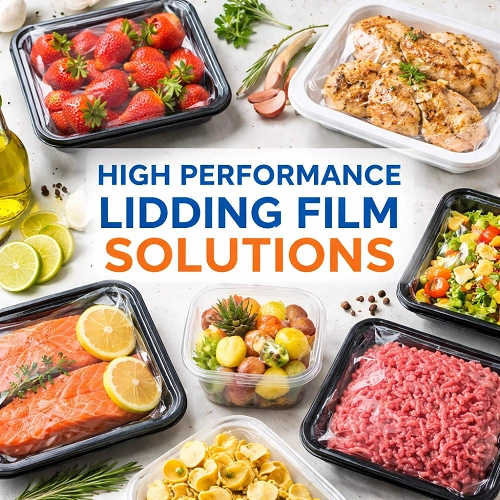

High performance lidding films are specialized polymeric films designed to seal containers—such as trays, cups, tubs, and pouches—across a wide range of industries. Their primary function is to protect and preserve the product’s quality, extend shelf life, ensure safety, and offer consumer convenience, while addressing manufacturing efficiency and sustainability goals.
What Are Lidding Films?
Lidding films are engineered plastic films used to close and seal packaging containers. They serve as the top surface for containers, providing a hermetic seal that protects goods from moisture, oxygen, contamination, and mechanical stress. Typical applications include food (fresh produce, dairy, ready meals), pharmaceuticals, medical devices, and industrial products.
Unlike basic decorative films, high performance lidding films balance functional performance with manufacturability and consumer usability.
Polymer Materials and Film Structures
High performance lidding films are typically multi‑layered and can be constructed using a blend of the following polymers:
1. Polyethylene (PE)
- High‑density (HDPE), low‑density (LDPE), and linear low‑density (LLDPE) variants
- Provide excellent sealability and toughness
2. Polypropylene (PP)
- Offers higher temperature resistance
- Good clarity and stiffness
3. Polyethylene Terephthalate (PET)
- Excellent mechanical strength and barrier to gases
- Good printability and heat resistance
4. Ethylene Vinyl Alcohol (EVOH)
- Exceptional oxygen barrier
- Often sandwiched between seal layers
5. Nylon (Polyamide, PA)
- High puncture resistance and toughness
6. Barrier Coatings & Metallization
- Aluminum vapor deposition or metal oxide coatings for enhanced gas/moisture barrier
Multi‑Layer Structures
High performance lidding films are typically co‑extruded or laminated into structures such as:
- Sealant layer (usually PE or PP): Bonds to the container.
- Tie layers: Promote adhesion between incompatible polymers.
- Barrier layer (EVOH, metallized PET): Controls gas/water vapor transmission.
- Structural layer (PET, oriented films): Provides mechanical strength.
The layer thickness and composition are optimized based on end‑use performance requirements.
Barrier Performance: Oxygen, Moisture & Aroma
Barrier properties are vital for product safety and shelf life:
Oxygen Transmission Rate (OTR)
- Measured in cc/m²/24h (at specific temperature/humidity)
- Low OTR is critical for products sensitive to oxidation (meat, dairy, pharmaceuticals)
- EVOH and metallized PET significantly reduce OTR
Water Vapour Transmission Rate (WVTR)
- Expressed in g/m²/24h
- Moisture barrier is critical for dry foods (snacks, powders)
- Good WVTR control prevents sogginess or moisture loss
Aroma Control
- Essential for products with volatile flavors
- Films can be engineered to retain aroma through specialized barrier layers or coatings
Seal Integrity and Performance
Seal performance is arguably the most critical functional aspect:
Types of Seals
- Fin seal
- Lap seal
- Crimped seals
- Heat‑seal, induction seal, peelable seals
Seal Properties
- Seal strength: Resistance to separation under stress
- Hot tack: Strength of seal immediately after sealing before cooling
- Peelability: For consumer convenience and recyclability
- Hermeticity: Critical for sterile applications
Advanced sealant layers are engineered to tailor:
- Activation temperature
- Seal window (range of temperature/pressure where seal is reliable)
- Adhesion to specific substrates (PET trays vs. polypropylene tubs)
Processing Considerations
Manufacturers must balance performance with production efficiency:
Forming & Sealing Equipment
- High speed form‑fill‑seal (FFS) lines
- Thermoforming vs. cold forming
- Compatibility with induction sealing systems
Heat Management
Thermal conductivity and stability affect:
- Dwell times
- Cooling requirements
- Energy consumption
Web Handling
- Dimensional stability
- Curl control
- Static management
Advanced films are engineered for:
- Consistent thickness
- Low particulate generation
- Good winding/unwinding behavior
Regulatory and Safety Compliance
Lidding films used in food and pharmaceutical packaging must meet stringent safety standards:
Food Contact Regulations
- FDA (U.S.) Title 21 CFR
- EU Regulation No. 10/2011
- Migration limits for monomers, additives, and NIAS (Non‑Intentionally Added Substances)
Sterilization Compatibility
- Gamma irradiation
- Ethylene oxide
- Autoclaving
Films used in medical or sterile packaging must adhere to ISO standards (e.g., ISO 11607 for terminally sterilized devices).
Sustainability & Circularity
Environmental concerns drive demand for sustainable lidding film solutions:
Lightweighting
- Reducing film thickness while maintaining performance
- Lowers material use and energy in production
Recyclability
- Mono‑material films are easier to recycle than multi‑polymer laminates
- PE and PP systems are preferred for circularity
Biobased & Compostable Films
- Bio‑PE derived from sugarcane
- PLA or other compostable polymers for select applications
- Must meet ASTM D6400 / EN 13432 standards
Tradeoffs often exist between barrier performance and recyclability. Innovations like recyclable high barrier PE films or coating technologies that avoid EVOH aim to address this.
Emerging Trends & Innovations
Active & Intelligent Lidding Solutions
- Oxygen scavengers integrated into the film
- Ethylene absorbers for fresh produce
- Time‑Temperature Indicators (TTIs) printed or embedded for cold chain monitoring
Digital Decoration & Smart Labels
- QR codes and NFC for traceability and consumer engagement
- High resolution flexo and digital print technologies
Microwave & Retort Compatible Films
- Designed for microwavable steam venting
- High heat resistance for retort sterilization
Application‑Specific Solutions
| Industry | Key Requirements | Typical Film Innovations |
| Fresh Meat | High oxygen barrier, puncture resistance | EVOH layers, nylon reinforcement |
| Dairy | Sealability to PE/PET, aroma retention | Tailored sealant chemistries |
| Ready Meals | High heat tolerance (retort), steam venting | PP/PE blends with vent channels |
| Pharmaceuticals | Tamper evidence, sterilization | Induction seal layers, high purity films |
| Produce | Moisture balance, anti‑fog | Anti‑fog coatings |
High performance lidding film solutions are sophisticated engineering systems that must balance barrier protection, sealing performance, processing compatibility, regulatory requirements, and sustainability. As packaging demands evolve—with a growing emphasis on environmental impact, automation, and intelligent supply chains—lidding film technology continues to innovate through advanced polymers, multi‑layer architectures, and functional additives.