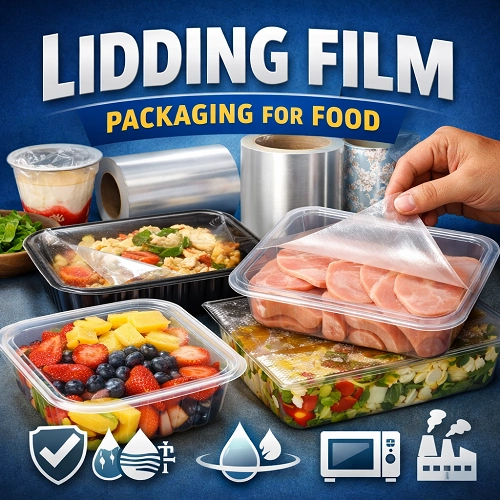

Lidding film packaging is one of the most widely used and technically developed solutions in the food packaging industry. It plays a critical role in protecting food products, extending shelf life, ensuring safety, and supporting efficient supply chains.
What Is Lidding Film Packaging?
Lidding film packaging refers to a flexible film used to seal containers—such as trays, cups, tubs, and trays—to protect and enclose food products. The film acts as a barrier between the product and the external environment, providing protection against contamination, moisture, oxygen, and physical damage. Unlike rigid lids, lidding film offers flexibility, cost-effectiveness, and customization potential, making it ideal for a range of retail and foodservice applications.
Core Components and Materials
Lidding film systems typically consist of multiple layers designed to achieve specific performance targets. The choice of materials and lamination structure depends on food product requirements, processing conditions, and desired shelf life.
1. Base Polymers
Base polymers form the core structure of the film.
Common polymers include:
- Polyethylene (PE): Offers good moisture barrier, flexibility, and sealability. Commonly used in refrigerated and frozen foods.
- Polypropylene (PP): Provides higher heat resistance and stiffness than PE, useful for hot-fill and retort applications.
- Polyethylene Terephthalate (PET): Delivers excellent mechanical strength and clarity; often used in high-barrier structures.
2. Barrier Layers
Barrier layers are critical for protecting food from oxygen, moisture, and aroma migration.
Key barrier materials:
- Ethylene Vinyl Alcohol (EVOH): Excellent oxygen barrier under dry conditions. Often sandwiched between other polymers to prevent moisture interaction.
- Polyvinylidene Chloride (PVDC): Offers strong barrier performance but has environmental and recyclability limitations.
Barrier materials are typically placed in the film’s intermediate layers to maximize performance without compromising seal integrity.
3. Sealant Layers
Sealant layers ensure that the film securely bonds to the package substrate (e.g., tray). These layers are often composed of sealable grades of PE or PP tailored to specific substrate materials and processing temperatures.
4. Functional Coatings
To facilitate processing and end-use performance, lidding films may incorporate functional coatings such as:
- Anti-fog: Promotes clarity and prevents condensation build-up, ideal for fresh produce.
- Anti-block: Reduces layer sticking during unwinding or processing.
- Release coatings: Make it easier to peel the film from the substrate.
Technical Processes and Fabrication
Film Extrusion and Lamination
Lidding films are typically manufactured using one of the following processes:
- Coextrusion: Multiple polymer layers are extruded simultaneously through a single die to form a multilayer structure. This allows precise control over layer thickness and functionality.
- Lamination: Separate films are produced and then bonded together using adhesives or extrusion lamination to create composite films with desired barrier and mechanical properties.
Printing and Decoration
Print quality and graphic messaging are achieved via flexographic or rotogravure printing. Printing may be done before or after lamination, depending on ink compatibility and process requirements.
Surface Treatments
To improve adhesion of inks and coatings, surface treatments such as corona or plasma treatment are applied. These increase surface energy, enhancing wetting and bond strength.
Performance Characteristics
When evaluating lidding film packaging, several performance parameters are critical:
Barrier Properties
- Oxygen Transmission Rate (OTR): Indicates how much oxygen permeates through the film. Lower OTR is critical for oxygen-sensitive foods.
- Water Vapor Transmission Rate (WVTR): Measures water vapor ingress or egress. Key for moisture-sensitive products.
Barrier performance impacts product freshness, flavor integrity, and microbial stability.
Seal Integrity
Seal strength and durability determine the package’s ability to withstand handling, transport, and storage conditions. Proper seal design minimizes leaks and contamination risk.
Thermal Resistance
Different applications demand films that can endure various temperatures.
For example:
- Retort Lidding Film: Must withstand high-temperature sterilization (typically 121–130°C) without losing seal integrity.
- Microwaveable Film: Requires heat tolerance and pressure venting features.
Mechanical Strength
Tensile strength, puncture resistance, and tear resistance are essential for protecting the food during packing, distribution, and retail handling.
Applications of Lidding Film Packaging
Lidding film packaging is versatile and used across many categories:
Fresh and Prepared Foods
- Fresh produce trays: Clear, anti-fog films for visibility and freshness.
- Ready meals: High-barrier films for extended refrigerated shelf life.
- Deli meats and cheeses: Films with tailored OTR/WVTR to balance respiration and moisture.
Frozen Foods
- Films with robust seal and low-temperature performance to prevent freezer burn and protect texture.
Shelf-Stable Products
- Retort films for products requiring thermal sterilization (e.g., sauces, soups).
Dairy and Desserts
- Films with peelability features for yogurts, puddings, and other convenience formats.
Sustainability and Recycling Considerations
Environmental impact is a growing concern.
Manufacturers are developing more sustainable lidding film options:
Mono-material Films
Films composed of a single polymer (e.g., PE) simplify recycling and align with circular economy goals. However, achieving high barrier performance with mono-material films can be technically challenging.
Recycled Content
Incorporating post-consumer recycled (PCR) or post-industrial recycled (PIR) resins can reduce carbon footprint, but requires careful control of material quality.
Compostable and Bio-based Films
Some films are formulated from biodegradable polymers or bio-based feedstocks. These options suit specific end-of-life pathways but must meet performance and cost thresholds.
Design and Regulatory Considerations
Food Contact Safety
Lidding films must comply with regulatory standards (e.g., FDA in the U.S., EU food contact legislation) regarding migration limits, material safety, and processing aids.
Consumer Convenience
Features such as easy-peel seals, reclosability, and portion control cater to consumer expectations while maintaining product integrity.
Supply Chain Efficiency
Lidding films enable reduced packaging material weight and volume compared to rigid alternatives, supporting efficient transportation and storage.
Challenges and Future Trends
Technical Challenges
- Balancing barrier performance with recyclability.
- Achieving robust seal performance across diverse substrates.
- Managing cost pressures in high-volume markets.
Innovation Trends
- Smart packaging elements such as oxygen scavengers or freshness indicators integrated into films.
- Advances in recyclable barrier technologies.
- Digital printing for variable content and traceability.
Lidding film packaging is a sophisticated and adaptable packaging solution that combines material science, engineering design, and application-specific performance. Its technical complexity enables food producers to deliver safe, high-quality products with extended shelf life, convenience, and sustainability benefits. As materials and processes continue to evolve, lidding film packaging remains a dynamic field with significant influence across the global food industry.