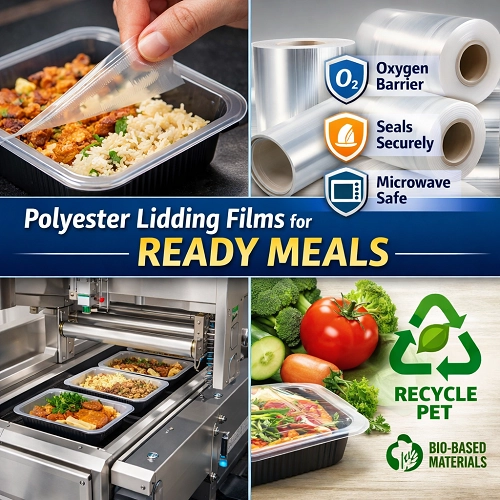

In the ready meal industry, packaging plays a vital role in product quality, safety, shelf life, and consumer satisfaction. Among the various materials used for sealing and protecting ready meals, polyester lidding films have emerged as a versatile and technically advanced solution.
What Are Polyester Lidding Films?
Polyester lidding films are thermoplastic films primarily made from polyethylene terephthalate (PET). These films are designed to seal trays and containers containing ready meals, ensuring freshness, hygiene, and physical protection throughout handling, distribution, and storage.
Unlike simple films used for wrapping, lidding films are engineered to perform under controlled sealing conditions—often with modified atmospheres, under refrigeration or freezing, and sometimes even for microwave heating.
Material Properties of Polyester Lidding Films
Chemical Structure and Composition
Polyester (PET) is a semi-crystalline polymer known for its excellent balance of mechanical strength, thermal stability, and chemical resistance. For lidding applications, PET may be used alone or in combination with other polymers via co-extrusion or lamination to enhance specific functional properties.
Key properties include:
- High tensile strength and stiffness
- Dimensional stability across a wide temperature range
- Low gas permeability relative to many polymers
- Excellent printability and optical clarity
- Good heat resistance for thermal forming and sealing
Barrier Performance: Oxygen, Moisture, and Flavor Protection
One of the most critical functions of lidding films is to protect the product from environmental factors that can degrade quality. Polyester lidding films are engineered to provide effective barriers against:
Oxygen Transmission
Oxygen accelerates spoilage and oxidation, especially in high-fat foods. PET offers relatively low oxygen transmission rates (OTR) compared to materials like polypropylene (PP), helping extend the shelf life of ready meals. Barrier levels can be further improved with barrier coatings or combined with materials like ethylene vinyl alcohol (EVOH).
Water Vapor Transmission
Moisture loss or gain alters food texture and safety. PET’s moderate moisture barrier characteristics help maintain product consistency. For meals sensitive to humidity, multilayer constructions with additional moisture barriers can be used.
Aroma and Volatile Retention
Flavor and aroma compounds are often volatile; effective lidding films minimize their escape, keeping meals tasting fresh.
Sealing Performance and Processability
The value of any lidding film is closely tied to how well it seals to the chosen tray material under manufacturing conditions.
Key factors include:
Sealant Layer Formulations
PET itself is not an ideal heat sealant; therefore, lidding films typically have a specialized heat-seal layer made from modified polyolefins (like modified PE) or co-polymers. These sealant layers activate at specific temperatures and pressures to create an airtight seal.
Sealing Window
The sealing window refers to the range of temperature, pressure, and dwell time in which a strong, hermetic seal is achieved. A wider sealing window gives manufacturers more tolerance in production, reducing scrap and downtime.
Compatibility With Tray Materials
Depending on the tray substrate—such as polypropylene (PP), polyethylene (PE), or recyclable PET trays—the lidding film formulation and sealant must be matched to ensure adequate adhesion without delamination.
Machine Compatibility
Polyester lidding films are used in various packaging machines, including:
- Thermoformers
- Tray sealers
- High-speed rollstock lines
Some films are optimized for high throughput, maintaining consistent performance at elevated speeds.
Functional Enhancements and Special Variants
Polyester lidding films can be engineered with additional properties tailored to specific ready meal needs:
- Microwaveability: Certain PET lidding films are designed to withstand microwave heating without warping or releasing harmful substances. These typically balance high temperature resistance with optimized permeability to allow pressure relief.
- High-Barriers and Modified Atmosphere Packaging (MAP): For meals with long shelf life or sensitive ingredients, lidding films can be combined with EVOH or nano-barrier layers to provide ultra-low oxygen transmission—crucial for MAP applications.
- Peelability: Controlled peel strength is key for consumer convenience. Films can be engineered to peel easily without tearing or leaving residue, while still maintaining integrity during transport.
- Printability and Branding: PET has excellent surface properties for high-quality printing, enabling branding, nutritional labeling, QR codes, and regulatory information directly on the film.
Sustainability and Recycling Considerations
As environmental concerns grow, the packaging industry is under pressure to minimize waste and improve recyclability.
Recyclability of Polyester Films
PET is widely recyclable. However, the recycling of lidding films depends on:
- Material purity (contamination with food residues)
- Layering complexity (monomaterial films are easier to recycle)
- Separation technologies at recycling facilities
Monolayer or cleverly engineered multilayer films designed for mechanical recycling are preferred over non-recyclable multilayer structures.
Lightweighting
PET lidding films can be made thinner without compromising performance, reducing material usage and overall environmental footprint.
Alternative Materials and Bio-Based PET
Industry research explores bio-based PET (from renewable sources) and advanced recycling processes like chemical recycling to further improve sustainability.
Regulatory and Safety Aspects
Because lidding films come into direct contact with food, they must comply with applicable food contact regulations such as:
- U.S. FDA food contact substance regulations
- EU Framework Regulation for food contact materials
- Migration and safety testing protocols
Manufacturers must demonstrate that films do not leach harmful substances under intended use conditions, including heating and refrigerated storage.
Practical Considerations for Food Manufacturers
Selecting the Right Film
Choosing an appropriate polyester lidding film requires consideration of:
- Product type (fresh, frozen, heat-and-eat)
- Processing equipment
- Shelf life targets
- Barrier requirements
- Sustainability goals
Quality Assurance
Routine checks include:
- Seal integrity testing
- Oxygen and moisture ingress measurements
- Peel force testing
- Visual inspection for defects or contamination
Cost Implications
While PET films may cost more than simpler films, benefits like extended shelf life, reduced food waste, and superior presentation often provide a favorable total cost of ownership.
Polyester lidding films represent a technically advanced and highly customizable solution for ready meal packaging. Their excellent mechanical strength, barrier performance, thermal stability, and processability make them suitable for a wide range of applications—from chilled fresh meals to microwaveable convenience foods. As sustainability and regulatory demands evolve, innovations in material science continue to drive improvements in polyester lidding films, balancing performance with environmental responsibility.