

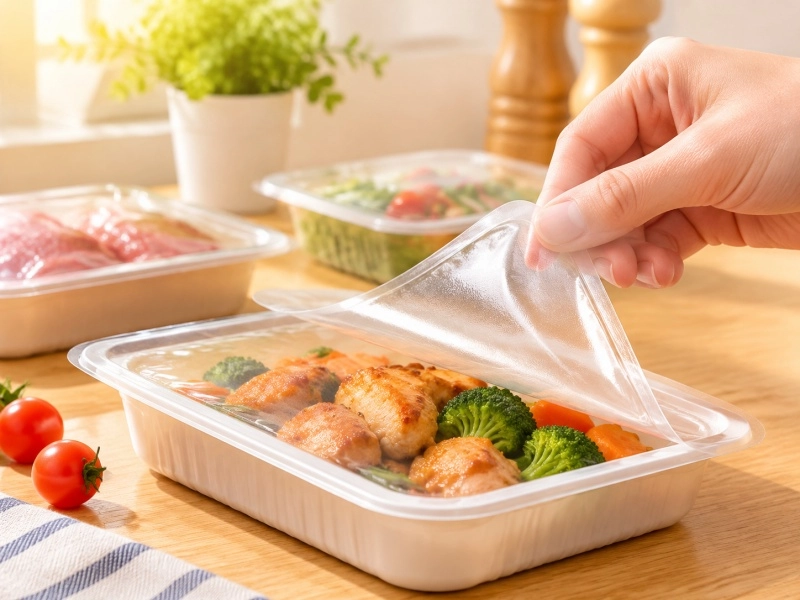
Peelable lidding film is widely used in food packaging applications such as dairy products, fresh meat, seafood, ready meals, and fresh produce. It allows consumers to open packages more easily while maintaining a reliable seal during storage and transportation.
However, different foods have different requirements for barrier performance, sealing strength, storage conditions, and opening behavior. Choosing the right film involves more than simply considering how easily it peels away. The film structure must also match the food, tray material, and packaging process.
Key Technical Factors to Consider
Peel Strength and Opening Consistency
Peel strength directly affects the consumer's opening experience. If the seal is too weak, the package may open during handling or transportation. If it is too strong, consumers may struggle to remove the lid or tear the film unevenly.
When evaluating peelable lidding film, consider:
- Peel force: The force required to remove the film should be appropriate for the package and intended users.
- Peel behavior: The film should peel smoothly without excessive tearing or unwanted residue.
- Seal consistency: Opening performance should remain stable across production batches and after storage.
Peel performance should be tested under actual packaging and storage conditions rather than judged only by the film's initial appearance.
Barrier and Sealing Performance
Barrier properties help protect food quality, while sealing performance prevents leakage and unwanted exposure to the external environment. The required specifications depend on the food type and expected shelf life.
A lower OTR or WVTR may be required for certain foods, but barrier performance alone does not determine shelf life. Food characteristics, processing conditions, storage temperature, and the complete package structure also matter.
Film Structure and Sealant Compatibility
Peelable lidding films are often made with multiple layers, each serving a different function. The outer layer provides mechanical protection and printability, while barrier layers help limit the transmission of gases or moisture. The sealant layer is particularly important because it determines how the film bonds to the tray.
The sealant layer must be compatible with the container material. Even a film with suitable barrier properties may produce an unreliable seal if its sealing layer does not match the tray or the packaging conditions.
Choosing Film for Different Food Applications
Different food categories require different combinations of barrier protection, sealing reliability, and opening performance.
Matching the Film to the Tray Material
The tray material affects heat transfer, sealing behavior, and the compatibility of the sealant layer. A film that works well with one type of container may not provide the same performance with another.
Three sealing parameters should be checked during packaging trials:
- Temperature: The sealing temperature must be suitable for both the film and tray.
- Pressure: Appropriate pressure helps achieve consistent contact between the sealing surfaces.
- Dwell time: The film and tray need sufficient contact time to form a reliable seal.
These parameters should be determined through testing on the actual packaging equipment. General settings cannot guarantee the same results across different materials and production lines.
Tests to Perform Before Bulk Purchasing
Before placing a large order, buyers should evaluate the film using samples and actual packaging conditions. The following tests help identify potential problems:
- Seal and peel testing: ASTM F88/F88M can be used to measure the strength of flexible barrier materials and seals. Evaluate both sealing reliability and opening behavior.
- Oxygen transmission testing: ASTM D3985 provides a method for measuring the oxygen gas transmission rate of plastic films and sheets.
- Water vapor transmission testing: ASTM F1249 is used to measure the water vapor transmission rate of plastic films and sheets.
- Low-temperature testing: Check whether the film maintains seal integrity and suitable peel behavior after storage at the intended refrigeration or freezing temperature.
- Food-contact compliance: Confirm that the materials meet the applicable food-contact requirements in the target market, such as relevant US FDA requirements or European Union regulations.
Test methods and acceptance criteria should be selected according to the packaging application. A general description such as "food grade" is not a substitute for checking the specific regulatory requirements and supporting documentation.
Working with a Film Manufacturer
To identify a suitable peelable lidding film, buyers should provide clear information about the intended application. Important details include:
- Food type and filling conditions
- Tray material and dimensions
- Refrigerated, frozen, or ambient storage conditions
- Required oxygen and moisture barrier performance
- Desired peel strength and opening behavior
- Packaging machine and sealing parameters
- Applicable food-contact requirements
Zhejiang Zhongcheng Packing Material Co., Ltd. focuses on the research and development, design, production, and sales of packaging materials, including barrier shrink films and food packaging films. Its product range includes lidding barrier shrink film, which is designed for barrier-oriented packaging applications. However, this product should not automatically be treated as equivalent to peelable lidding film. The film structure, tray compatibility, and required peel performance need to be confirmed through technical evaluation and sample testing.
Frequently Asked Questions
1. Can Peelable Lidding Film Be Used for Frozen Foods?
Yes, provided that the film structure and sealant layer are suitable for the intended freezing conditions. Low-temperature testing should confirm that the seal remains intact and the film can still be peeled as required after storage.
2. Does Peelable Lidding Film Provide High Oxygen Barrier Performance?
It can be designed with oxygen barrier layers, but peelability and oxygen barrier performance are separate properties. Buyers should specify the required OTR and peel strength rather than assuming that all peelable films offer the same barrier level.
3. Can One Peelable Lidding Film Work with Different Tray Materials?
Not necessarily. PET, PP, PS, and CPET have different material characteristics and sealing requirements. Compatibility should be verified through tests using the actual tray and packaging equipment.